Adventure #5: Glen Haven, Aral, & Jacktown

We survived the night in our seedy motel, which was all that was available in Traverse City on Labor Day weekend, and headed west, deeper into the Leelanau Peninsula.  We had a couple of spots marked on the map that we definitely wanted to see.

Our first stop of the day (after breakfast, of course) was Glen Haven, which is part of the Sleeping Bear Dunes National Lakeshore.  Glen Haven isn’t the type of ghost town we traditionally visit; while it is an abandoned town, a few of the buildings are now maintained by the State and are on display for the public.  It’s part of the trails that run all through the area and makes a nice stop for hikers, bikers, or people just passing through by car, like us.

This slideshow requires JavaScript.

The place has the old canning factory, which now houses several types of boats and lighthouse paraphernalia; it’s also a good place to get some literature about the area, and/or get a lesson on it from one of the park rangers.  There’s also a general store (which unfortunately was closed when we went) and a working blacksmith’s shop–there was a demonstration going while we were there.  Also, a few old houses, some of which have interesting signs discussing the home’s past.  It was definitely worthwhile to visit, if nothing else to take in that unforgettable view:
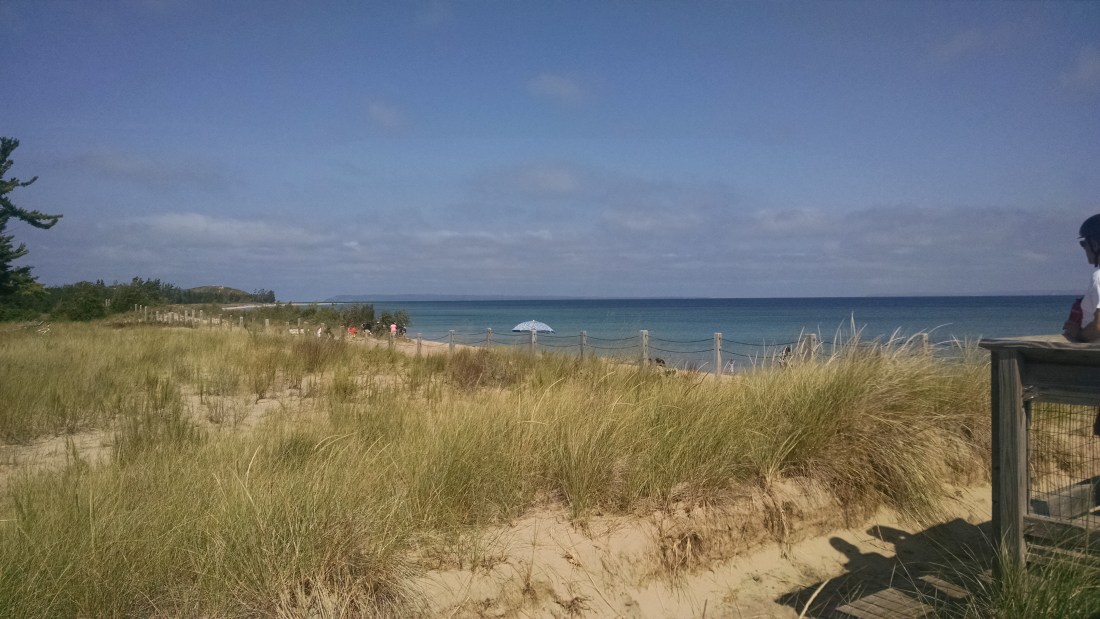
IMG_20170903_114806670.jpgWe may be a little biased, but Michigan dunes and lakeshores are honestly among the most beautiful in the world.  From this point, you can get a good look at the Manitou Islands–which we also read had some ghost towns on them, so next year’s trip is already in the making!

From there, we headed towards Aral, which we read about in a pamphlet at Glen Haven.  Unfortunately there isn’t much there.  It’s south of Empire, off of Esch Road…and apparently that’s all it is.  A road.  So nothing worth even taking a picture of, unfortunately.  We moved on.

Finally, we made one last stop in a place called Jacktown.  There is very little left of it here; the research we found is that this is just another one of those little company towns that sprung up with the growth of the lumber industry and the railroad, and died off just as quickly once the area was logged out and the railroad was dismantled.  It’s near Empire, in Leelanau county, although crossing the road takes you right into Benzie county.  To find it, we headed south on state road 677 and then turned left on Oviatt/County Line Road.  According to a few different online sources, there may be some old foundations of buildings still around in the woods, but we thought the better of exploring too much off road, since there appeared to be a relatively active lumbering site there, and there were sounds of gunfire echoing in the woods.  We stuck to locating Bland Cemetery, which is the only real remain of the town.

The cemetery is so tiny–only 18 interments on record, and not all of those appear to have stones.  The cemetery was established in 1868, and the last known burial here was in 1926, although the majority were in the late 1800’s.

IMG_20170903_140010317

As usual, Issa tried to be helpful and take pictures of anything that needed to be added to Findagrave.com, but as previously stated, not all of the headstones were there, and all of those that were there had already been posted to the website.  On Findagrave.com, there appeared to be a lot of work done to really flesh out what we know about these people–death certificates, etc. were all uploaded, so it was interesting to read the entries.  One of the most fascinating ones we read caught our eye, for one thing, because of the name: Idonia Melvina Bolt Van Wormer-Verno.  I mean, how do you even fit that on a headstone?  Apparently you don’t, because it was nowhere to be found.  An elaborate write-up on her family tree is posted on Findagrave, and the last paragraph is the most intriguing:

Four days before her death, Melvina married Paul Verno, Sr.  He buried her in a secret location that remains a mystery to this day.

(This, after having having eight or nine children and then living as a widow for some time).

So, according to record, she is supposed to be in Bland Cemetery, but there is no marker with her name on it.  She was only 42 when she passed away.  None of her children, her first husband, nor her second husband are buried there.  A quick search located Paul Verno’s grave in nearby Empire, in the St. Phillip Neri Catholic Church cemetery.  Of course, he’s also listed there as having three possible wives, some of which were concurrent, so we’re unsure what the real truth is behind this family.  Some real intrigue, though!

Here are some photos of other stones we saw there.  Most were quite simple:

This slideshow requires JavaScript.

Lots of Blands, Ames, and Huff families represented here.

As the sounds of rifles shooting in the woods were getting louder, we thought it was prudent to leave!  We made our way home, stopping in Cadillac at Mr. Foisie’s Pasties, which were excellent and we highly recommend them!  A bit of fudge from Gramma’s Treats in Baldwin might have also been consumed en route *smile*.

Overall, it was an excellent adventure–so much we saw and learned!  We can’t wait for the next one!

Adventure #4b: Idlewild and Marlborough

After our adventure in Nirvana, it seemed like the day was a complete success.  But as we continued west in search of the last small town on our list for the day, we saw a historical marker on the side of the road:

IMG_20170902_134337384

We both looked at each other in complete disbelief.  How did we not know about this?  We’re both lifelong Michigan residents and had never heard of anything like this.  Another sign close to this one pointed the way towards a “cultural center and museum,” so we simply had to go investigate.

The museum there is small, but well-appointed and full of wonderful exhibits.  The ladies working there that day were incredibly friendly and even invited us to sit down and showed us a short film that was made by a Detroit news organization celebrating Idlewild–its founding, its heyday, and its decline.  The film looked to have been shot in the late 1980s and early 1990s, so they still had many people to interview who were still alive and had memories of visiting the resort.  There’s also a good write-up about it here by the Detroit Free Press.

Basically, this resort town was created in the early part of the 20th century as a place for African Americans to vacation (and entertainers to come and perform), as they weren’t welcome at mainstream establishments due to segregation.  Apparently, if you had any means at all, you spent your summers there and it was glorious.  Nearly every major African American entertainer performed there at some point, and there were multiple night clubs, as well as more family-friendly types of establishments, too.  After the Civil Rights Act was passed in 1964, and entertainers were able to go to the more traditional spots–Las Vegas, Atlantic City and the like–the resort went into decline.  Now very few of the original buildings are there, and many are boarded up.  We didn’t venture towards the lake, as there were private homes there that some people do still live in and we didn’t want to intrude, but we did get a few pictures from the road:

IMG_20170902_134549920

We spent a good amount of time chatting with the ladies in the gift shop and viewing all the artifacts they had on display.  It was unbelievable to us that we had never heard of this place that was so important to Michigan history, and that got us into a long conversation about race and privilege.  We thought deeply about how one man in the video we’d watched talked about how his mother would pack the car full of meals for the whole family as they made the trip north from Detroit in their car.  As a child, he’d said, he just thought it was being economical; as an adult, he realized it was because there would not have been any restaurants along the way that would have served them.  They ate in the car because they had no choice.  And at the same time, Detroit was booming largely because of the labor provided by blue-collar workers in automobile factories (many of them African American) and by the growing music industry (again, inspired by and built by African Americans).

The women working at the museum said that there are efforts at present to revitalize the area and build a community center.  It is still a very beautiful place, despite the closed-up buildings; it’s northern Michigan to a tee–beautiful woodlands and a lake.  It’s a place very much worth saving.

After we finished up in Idlewild, we continue west on M-10 to the town of Baldwin (not a ghost town–very much alive!)  As became a habit with us on this trip, we realized we hadn’t eaten lunch and it was 3:00 p.m., so we made a stop and ate.  We’d also been told by the Idlewild ladies to check out Gramma’s Treats, so we walked there from our lunch spot and were NOT disappointed!  Some of the best fudge EVER in so many flavors!  The orange cream was surprisingly delicious, and the more traditional chocolates were also amazing.  Gramma herself is also very kind and even gave us each a free homemade donut for the road (also delicious).  If you’re ever in the area, stopping by there is a must!

She also gave us some information on the next ghost town we were hoping to see, which was Marlborough.  She said the area used to be well open to everyone, and she’d gone there to play and party as a youth.  She thought it was probably all blocked off now, and unfortunately she was right.  We headed south from Baldwin to find whatever we could of the place, and all that we were able to see was the old cement factory, around which the whole town had been built:

This slideshow requires JavaScript.

A Lansing-based radio station did an overview of the town, and also threw in directions to find it, which you can read here.  Here’s the thing, though; the article states that you can go through the woods to find more ruins, beyond what can be seen from the side of the road.  However, if you look at the pictures above, the KEEP OUT signs are clearly visible, as is the barbed wire fencing around the whole thing.  So I’m thinking Gramma knew what she was talking about; she also mentioned that the ground there is considered unstable from all the quarrying and blasting they did, getting materials for the cement plant.  So while we wouldn’t have necessarily been averse to trekking out into the woods in search of old buildings, it looked like it might have been more difficult (and come with legal consequences) than the author of that article imagined.

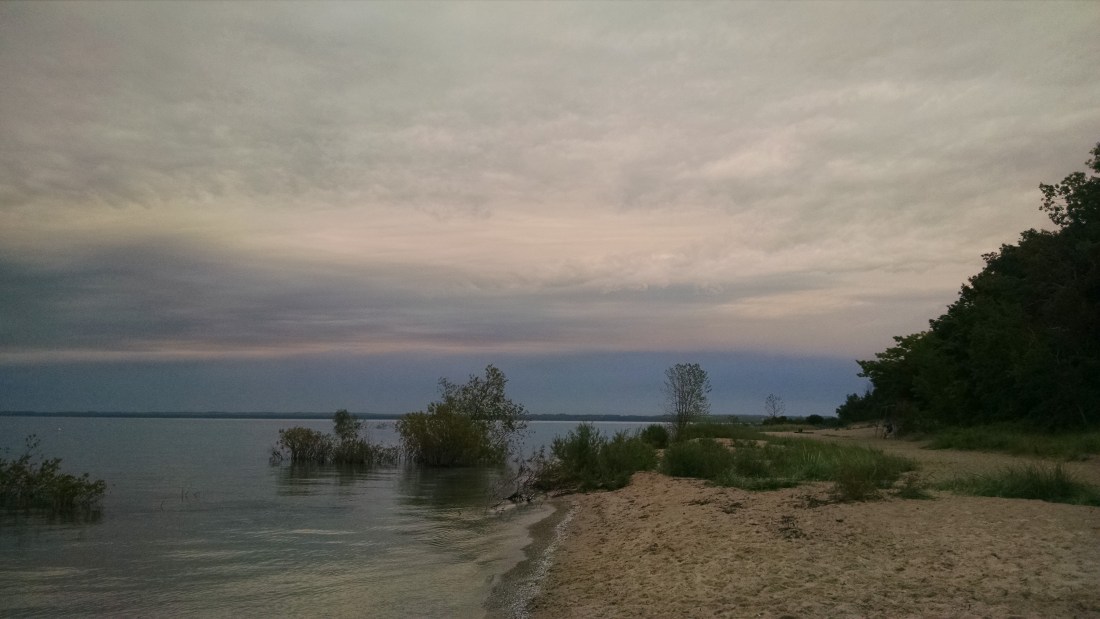
After all this excitement, we were quite exhausted!  Our plan was to check out some more spots in the Leelanau Peninsula, so we headed north to Traverse City.  We got the timing right and managed to see a Lake Michigan sunset (although unfortunately, it was a bit cloudy and rainy)!

IMG_20170902_200231782.jpg

And then began our saga of finding the seediest, most out-of-date, crappy motel to be had in northern Michigan (let’s put it this way: we got half off the room rate because there was no heat), and putting aside our fears of being captured by a serial killer, we rested up for the next day’s adventure!