It’s summer in Michigan and what does that mean? Time for Issa and Sara to make a grand adventure! We’d been planning this one for some time, since we knew that there are many, many ghost towns and abandoned places to be found in Michigan’s Upper Peninsula. In fact, there were (are) so many that we didn’t even try get to all the ones that we knew existed, and rightly so, because with all the crazy twists and turns of our trip, we didn’t even get to see all the ones we planned to see. We still saw a lot, though, and have returned to tell the tale!
On Friday morning, we headed north over the Mackinac Bridge. The first thing we noticed as we began our UP adventure is that what qualifies as a “ghost town” and what is actually still a town is a very flexible situation. Many so-called “ghost towns” are still on the map and may still have residents year-round. Also, what is “old” and what is “new” is also quite blended together, with towns declining and re-flourishing in different ways over the years. Therefore, we had to use our best judgement about what to spend time on and photograph, especially given the limited nature of our time up there.
For instance, we passed through Moran, MI on Highway 123, not too far north of the bridge. Our research had led us to believe it was a ghost town, but it seemed to be just a small village—perhaps not thriving, but still there and holding its own. We decided not to take pictures there for that reason, and carried on further on 123 to Ozark.
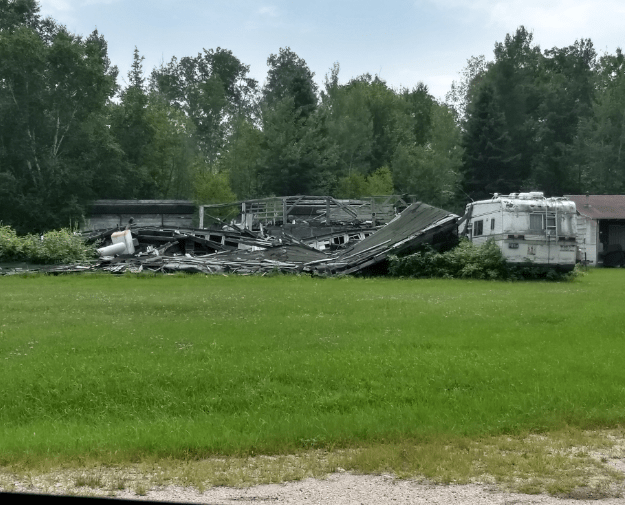
This was a ghost town worthy of the name. Turning left on Ozark Road took us to all that remains of the town, which is not much. We saw a house or some such structure that had been recently razed—lots of detritus on the ground. This was apparently the last original house left from Ozark, although next to the rubble was a private residence of indeterminate age. We took our pictures of the place and left them in peace.
In doing our research, Ozark was founded in 1875 as a lumber town, and was originally called Johnson. It thrived in the early part of the 1900s, but by the mid-1960s, it petered out. It appears that other towns closer to the mainland, like Saint Ignace or Sault Ste. Marie, might have thrived instead. We also found the town’s Facebook page, which has some great historical photos on it.
After Ozark, we had to make some priority decisions about where to go next. Seewhy and Soo Junction were both potential candidates, but a little research yielded that not much was left in either town, so we moved on to more promising sites. We do hope to visit them in the future when we have a little more time.
Our next destination kept us heading north on Highway 123 in search of Emerson and Shelldrake. There really wasn’t much of anything in Emerson to photograph, unfortunately. The town was apparently founded in 1882 as a lumber town with a healthy fishing industry as well. However, after both industries ran out, the town faltered and the land was eventually given over to the State of Michigan as part of Tahquamenon Falls State Park. There was a sign for the town, but not much else. The real excitement began when we went looking for Shelldrake. This town was the first ghost town in Michigan that Issa ever heard of and she’d always wanted to see it. Our research showed that it was a great one to see—several buildings still standing, plus an State of Michigan historical marker. The trick, as ever, was finding it.
We had some fairly specific directions on how to get there—once you’re north of Paradise, turn right on Superior Rd. There is a small neighborhood (for lack of a better term) of cottages there, taking advantage of the beautiful lakeshore. The directions say to take a right at the first road bend, which puts you on a dirt path, and the buildings and State historial marker are on the right side. We discovered later that this directions were accurate—however, there is also a private property sign, and we were trying our best, as ever, to honor that. So we thought maybe the directions were wrong, or we were misinterpreting them (there is a Superior and a North Superior Road, so easy mistake). We doubled back and tried to find another way. This led us to….
…a junk yard.
And unfortunately, this junk yard had a very sandy dirt road. And you know what they say about sandy dirt roads. That’s right. You’ll get stuck in them.
Yes, stuck. In a ghost town junk yard.
We tried to be resourceful, independent women. We used our resources. We dug ourselves out of the sand as much as we could. But it just wouldn’t work.
We called AAA. They laughed at us. We were laughing too, though, to be honest.
At the prospect of waiting an indeterminate amount of time and paying large out-of-pocket fees to the tow company, Issa reluctantly made her way next door to the cabins to look for help. She also found Shelldrake. It was right where it was supposed to be.

We enlisted help of three men, whom we shall refer to as Old Grumpy, Unicorn Tattoo, and Beer Can. Old Grumpy owns the entire property (Shelldrake, the cabins, and the junk yard) and was, well, grumpy about our situation. We tried to explain that we were only looking for Shelldrake to add to our photo collection of ghost towns, but he didn’t think that was much of a reason to drive on his property (which, in fairness, we didn’t know was his and it was not marked as private property in any way). We are unsure how Unicorn Tattoo was related to Old Grumpy, but he came along and was actually very helpful in pulling us out with their truck. Beer Can was renting a cabin from Old Grumpy for the weekend and was the first person Issa encountered. He was helpful enough to get Old Grumpy and Unicorn Tattoo, but then just wandered over to watch the action, with, obviously, a can of beer in hand. We paid the gentlemen in fine double chocolate chip cookies from Goodale’s bakery in Grayling. It was the best currency we had.
Anyway, about Shelldrake. The area itself has been used for hundreds of years, first by Native Americans as a seasonal fishing settlement, and then by pioneers hoping to move lumber on the Tahquamenon River. It was established as a formal (non-Native American) settlement in the late 1800s. It had all the trappings of a fairly civilized life for northern Michigan at the time: a school house, a hospital, a saw mill, a post office, an ice house to store meat for 1,000 people, and even had hot water piped in its buildings with a sawdust burner heating the water. There was a stagecoach from there to Eckerman, MI and a passenger ship between there and Sault Ste. Marie. Unfortunately, a fire at the saw mill in 1925 brought about the end of the town’s industry and ultimately the town itself. The land was purchased by a private owner in the 1930s and the historical marker erected. While there may have been plans at one point to turn the area into a resort of some kind, all that ever came of it are a series of cabins that can be rented by Old Grumpy.
So, it was a very eventful first day of our adventure. Three ghost towns, a few hours stuck in a junk yard, and ending the day visiting the Great Lakes Shipwreck Museum at Whitefish Point and Tahquamenon Falls on our way to Newberry, where we had a hotel reservation (yes, we learned our lesson from last year).


 Travels with Abandon